Enjoy Kanazawa's Enchanting Winter
Being located close to the Sea of Japan, Kanazawa experiences heavy snowfall in winter. Although Kanazawa is known for the beauty of each of its seasons, the winter scenery of the city is always praised to be one of the best in Japan. Historical districts and gardens such as Nagamachi or Kenrokuen Garden become even more beautiful in the snow.
If you’re after a snow-covered scenery, the world of almost colorless colors seen in ink drawings, January or February is the best bet.

Oyama Jinja Shrine
The "Shinmon" gate, which shows the Guillaman, is stunningly beautiful!
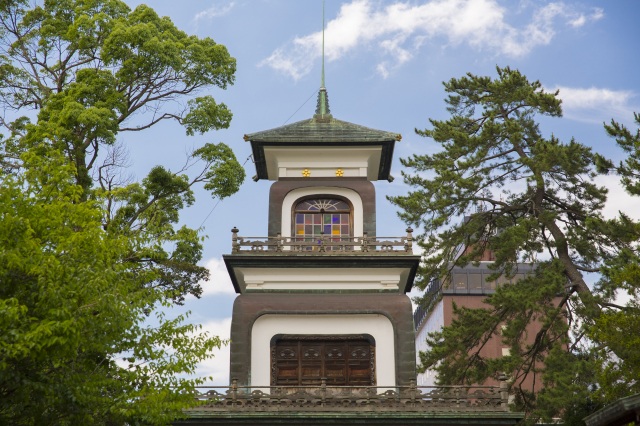
Our starting point today is the Oyama Jinja Shrine, which is dedicated to Maeda Toshiie, the first lord of the Kaga Clan. The shrine was originally constructed in 1599 by Toshiie’s successor, Toshinaga, on Mount Utatsuyama, and was moved to its present location in 1873. Look out for the beautiful gate with its stained-glass windows. It’s a peculiar mix of traditional Japanese, Chinese, and European religious architectural elements and has been designated a cultural asset of national importance.
One of the highlights of the shrine in the snowy season is the Sin-en strolling garden with its ponds and bridges, which were designed to resemble old Japanese musical instruments. Situated in the middle of the bustling downtown area, it really provides a tranquil sanctuary amidst the clamor of modern life.
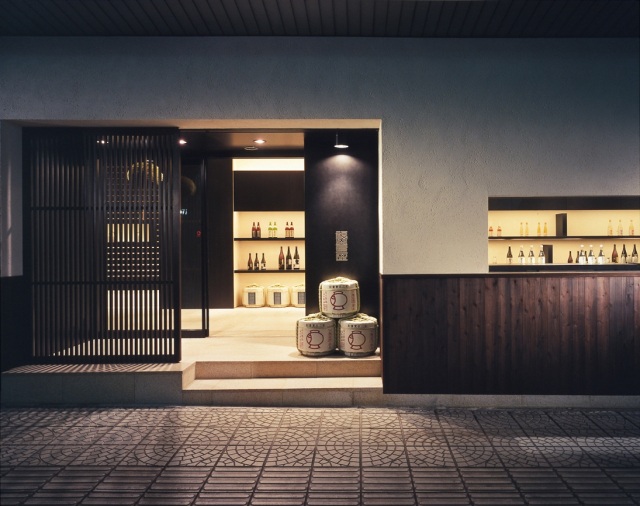
SAKE SHOP Fukumitsuya Kanazawa
A long-established sake brewery that has been in Kanazawa for over 390 years
The coldest part of the winter, with its dancing snowfall, is also the busiest time of year for Kanazawa’s sake distilleries. Around this time, each sake brewery in Kanazawa enters its peak season of sake brewing.
With its cold winters and heavy snowfall, the city is perfectly suited to sake brewing. Wellington visited the sake shop at Fukumitsuya, one of the established sake breweries in Kanazawa.
They also offer visitors brewery tours to discover both how sake is made and how it tastes. A tour can be conducted by a bilingual guide if a reservation is made in advance (English or French).
Nagamachi District
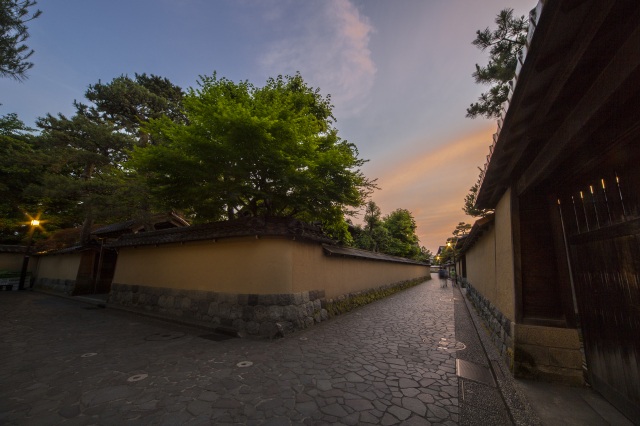
Next, head for Nagamachi, where samurai and their families used to reside. Although most of the original buildings are now gone, the alleys and ocher mud walls preserve the atmosphere of the old days.
Wellington spotted some finely knitted straw mats on the mud walls. These are called komo, and gardeners hang them on the mud walls in December of every year. This unique work, called komo-kake, signals to the people of Kanazawa that winter has arrived.
Komo-kake is done mainly to protect the mud walls from freezing, but it also has the added effect of instilling this historical area with a romantic atmosphere. “That is why the locals recommend that I visit this district in the winter,” says Wellington.
Nomura Samurai Family Residence
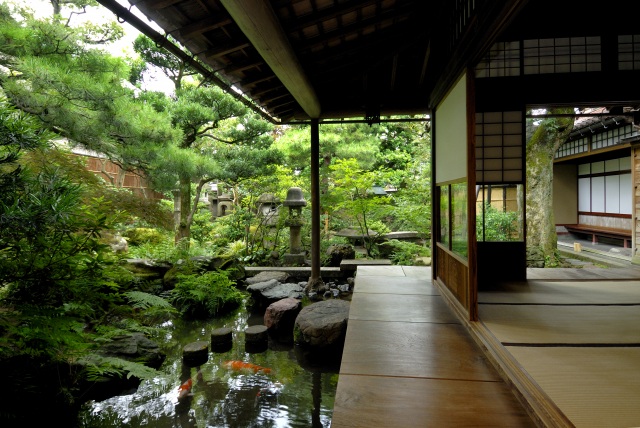
One of the main attractions in Nagamachi is the Nomura Family Samurai Residence. Located in the middle of the district’s main street, it has two stars in the Michelin Guide.
The private gardens in this district were originally designed to have a stream of water entering them from the canal. The Nomura family’s small garden, ranked as the third-best Japanese garden by a US-based technical journal, is no exception. You cannot help but be overwhelmed by the clever design techniques used to create such perfect beauty in such a small space.
After appreciating the frosty garden on the 1st floor, try a cup of matcha green tea on the 2nd floor. The corridor leading to the 2nd floor is also pretty interesting.
Although Wellington is not good at seiza, the Japanese way of formal sitting, he really enjoyed the tea and confectionery as well as the view from the classical tea ceremony room.
21st Century Museum of Contemporary Art
A hub for contemporary art in Kanazawa
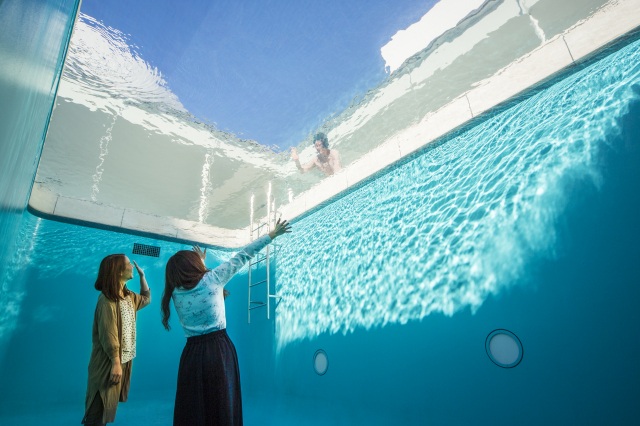
The 21st Century Museum of Contemporary Art, Kanazawa opened in 2004 in the center of Kanazawa, just a few steps from Kenrokuen Garden along Hirosaka Street, and it exhibits works by prominent contemporary artists from both Japan and all over the world.
Designed by SEJIMA Kazuyo + NISHIZAWA Ryue / SANAA, two internationally acclaimed architects, the museum features a unique circular building that houses the variously sized exhibition rooms. The museum is always busy with visitors, so we have come here early today to enjoy some solitude with the outdoor exhibitions and to walk along the curved glass of the exterior facade.
If the full tour of the museum leaves you feeling drained, why not look out for the row of SANAA “Rabbit” chairs inside, or the circle of SANAA “Drop” chairs outside, for a rest?
Kenrokuen Garden
A Beautiful and Famous Garden in the Heart of Kanazawa
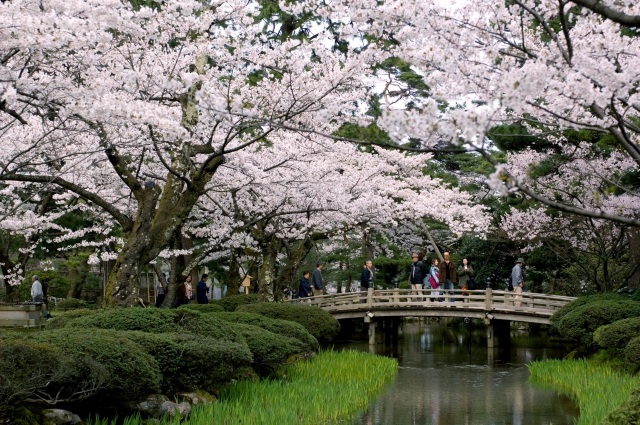
Kenrokuen Garden is a popular tourist attraction in Kanazawa, so we won’t go into a lengthy explanation. The spacious grounds were formerly the outer garden of Kanazawa Castle and were constructed by the Maeda family over a period of almost two centuries.
The garden was created in the chisen-kaiyu style and features a path around a central pond and springs. It is particularly beautiful in the winter. One of the garden’s most remarkable aspects in this season is yukitsuri, a traditional technique of using rope to support the trees’ branches to prevent them from collapsing under the weight of the snow. For a limited time over the winter, the garden is open and lit up in the evening to allow visitors to enjoy the picturesque scenery.
Kanazawa Castle Park
One of Kanazawa’s key historic landmarks
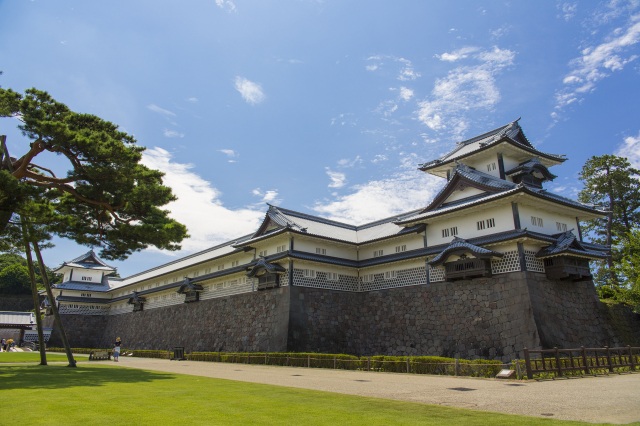
As you leave Kenrokuen Garden, cross the bridge and pass through the imposing Ishikawa-mon Gate into Kanazawa Castle Park. The contrast between the silvery white of the gate and the bright blue sky is spectacular.
Kanazawa Castle is the fortress where Lord Maeda worked and lived with his family. The first feudal lord, Maeda Toshiie, began building work on the castle in earnest in 1583. Sadly, however, some parts of the castle have been destroyed over the centuries in a number of fires. Some of the buildings have since been rebuilt and restored during the modern time. “Those current buildings are designed based on how they looked in the 1850s,” we explained to Wellington as we walked past a complex of three buildings: the Hishiyagura tower, Gojukken Nagaya armory, and Hashizume-mon Tsuzuki Yagura tower.
Kanazawa Oden Dinner
Now it’s time for our oden dinner!
Allow us to introduce oden. Oden is a simple hot pot dish that is very popular in Japan, especially on cold winter days. Various ingredients such as fish cakes, tofu, vegetables, and whole eggs are simmered in a soy sauce-flavored broth and eaten with a dash of hot mustard. The ingredients used differ by region.
With many specialty oden restaurants, Kanazawa is known as an oden mecca. Step into one of the rustic oden restaurants, sit at the counter in front of the stove to choose your own ingredients, order some local hot sake, and enjoy the gourmet delights! You can also enjoy chatting with local people, who will be curious as to where you are from.
Kanazawa Light-up Bus
The Kanazawa Light-up Bus is a round-tour bus that visits illuminated sightseeing spots in the city center, providing a great end to your winter walk.
We hopped on the bus, admiring a series of beautifully illuminated historical buildings from the window. “The nighttime streetscape has a completely different appeal from that of the daytime,” said Wellington.
The Kanazawa Light-up Bus runs every Saturday, departing from each bus stop every 10 to 20 minutes. If you have time and are not bothered by the cold weather, we recommend you get off the bus at any stop to enjoy a nighttime stroll.